
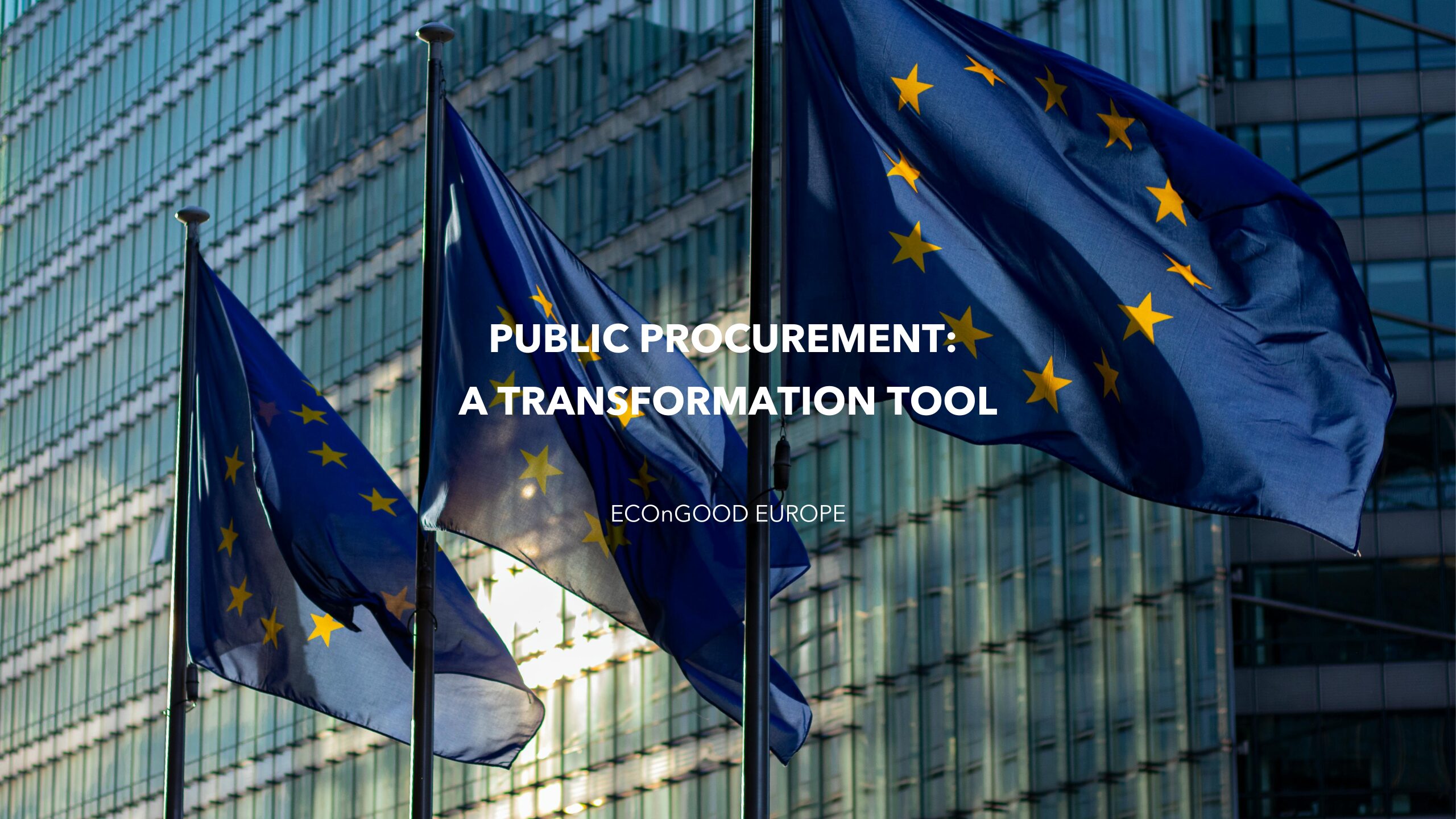
The ECOnGOOD EU Policy working group released a position paper to guide the transformation needed for one of the most powerful yet underused tools: public procurement. Annually, over 250.000 public authorities spend €2 trillion on such procurement, around 14% of the EU’s GDP, so ECOnGOOD calls on EU institutions and Member States to consider 7 proposed recommendations.
- Make socio-ecological criteria binding in all public procurement
- Prioritise resilience, regional value creation and security of supply
- Enable fair access for SMEs and value-based enterprises
- Use procurement as a strategic management and transformation tool
- Establish robust monitoring, transparency and accountability mechanisms
- Create enabling infrastructure: platforms, networks and competence centres
- Align public procurement with EU sustainability and accountability frameworks
The new rules should require authorities to systematically integrate social, environmental and human-righs criteria so the use of financial resources protects the people, the planet and future generations.
At times of climate crisis, geopolitical instability, resource scarcity and growing social inequalities, value has to mean more than price. “Building long-term resilience has become an urgent global priority, not only because of the multiple crises we are currently facing simultaneously, and public procurement is a key lever for achieving this in Europe.”, evaluates Walter Kern. According to Kern, European economy needs to be supported by a procurement policy that favors short, transparent and resilient supply chains that recognises regional value creation and local employment as legitimate award criteria to reduce dependence on environmental and social high-risk global supply chain. “Stronger regional and European supply networks built through such procurement choices increase crisis-resilience, lower emissions, and enhance long-term economic security”, adds Kern.
Revising these practices, as proposed by the Commission President Ursula von der Leyen, can impact the new rules. In September of 2025, European Parliament asked for simpler and more strategic procurement rules, meaning that the process has to aligned to sustainability, resilience, digitalisation and reduce administrative layers. This can result in more secure key supply chains and support production from EU small and medium sized enterprises. However, some concerns rose on green, social and sustainability considerations not being central as competitiveness in this current framing. Commission still has to publish its proposal so the file can go through the regular EU legislative process.
“As a consumer, every euro you spend is indicating your preferences, not just on the price of the product, but also the quality, and where you it. Spending your money on a sustainable product from a local shop is not the same as spending it on cheap products from a large online retailer”, explains Joost Mulder. European markets need to aim for a fair and future-proof scenario where socio-ecological values are accelerated, strategic dependencies reduced and that the public money serves the common good. “I want to make sure that when my city buys coffee for the city hall, or gardening services for our parks, that it is spend in a way aligned to our political values, whether that means buying a fair trade, avoiding pesticides, or creating jobs for unemployed local youth. Not changing public procurement rules will keep too many governments focusing on the ‘cheapest’ product only”, remarks Mulder.
See full position paper here.
Stay connected to our movement by subscribing to our international newsletter.