
From 27 September 2026, consumer-facing sustainability claims and use in the EU of the ECOnGOOD Label and Common Good Matrix Balance Sheet and results must comply with Directive (EU) 2024/825 and national law. The International Federation for the Economy for the Common Good e.V. (ECOnGOOD) does not offer these tools as a basis for external claims.
The Common Good Matrix and Common Good Balance Sheet are organisational reflection and improvement tools. Historical assessments reflect the methodology used at the time and are not current environmental certifications. More information.

In it’s relatively short history, since 2010, ECOnGOOD has made remarkable progress by carving out a space within local and regional governments, including the European Union.
The Common Good Balance Sheet is an instrument which promotes a value-driven, ethical economy. Its impact and significance go beyond legal requirements in order to ensure the highest possible standards in the future.
More and more consumers are looking for fairer and more sustainable products and services. The European Union, along with governments and political parties across Europe have recognized ECG as an effective tool to provide more transparency to consumers, regulatory organisations and other stakeholders.
The Economy for the Common Good model can inform Corporate Social Responsibility (CSR) and elevate it to a new level, partly because it has been so comprehensively designed, but also because it is a self-assessment tool that allows organisations to evaluate their contribution to society and the environment.
The Common Good Balance Sheet sets an example for the future. By identifying the advantages this creates for society as a whole, ECG pioneers have become the driving force for socio-political developments and future economic policy.
ECOnGOOD is a non-profit, not a political party. It attempts, however, to find supporters across parties and groups, similar to the strategy of human rights, peace, gender justice or environmental NGOs. Meet some of our supporters below and discover the diverse groups we work with.
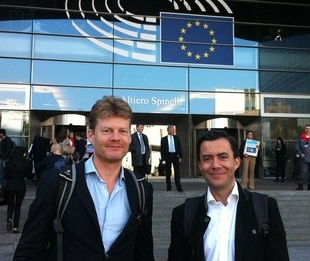
Christian Felber and Diego de Isabel la Moneda at the European Economic and Social Committee in Brussels.
European Union: ECG as a vehicle for creating a European Ethical Market
The European Economic and Social Committee’s (EESC) recognition of the merits of the Economy for the Common Good is pointing the way. In its plenary session on 17 September 2015, the EESC approved an opinion on the Economy for the Common Good with a majority of 86%. The outcome of this vote was also a clear instruction to the European Commission: in the framework of the renewed non-financial reporting strategy, those enterprises that can demonstrate a higher ethical performance should be rewarded. On request of the European Commission, the EESC answered in 2017 with an explanatory opinion on New Sustainable Economic Models, in which the ECG was mentioned twice again, and the 2015 opinion was referred to.
EU Non-Financial Reporting Directive
In accordance with the EU Non-Financial Reporting Directive (2014/95/EU), large scale companies are required to disclose non-financial information as of 2017. The objective of this directive is to increase the transparency of an organisation’s business activities, and the impact they have, especially with regard to environmental, social and employee-related matters. It is hoped that the benefits of non-financial reporting, mandatory for large scale organisations, will have a positive impact on small and medium-sized enterprises as well.
The directive requires European Union Member States to transpose the rules into their national legislation. In preparation for this, the Common Good Economy presented its Common Good Balance Sheet to the federal legislature of Austria and Germany as an example of effective reporting.
United Nations
In 2017, the United Nations Development Programme invited the Economy for the Common Good for the first time to present its concept. In 2019, the ECG model is referred to in an UNRISD Working Paper “Sustainable Development Impact Indicators for Social and Solidarity Economy”.
National Level
Political decisions and legislation in support of ECG can already be found in several countries.
Christian Felber was invited in 2016 to the German Bundestag as an expert on the European Union’s Non-Financial Reporting Directive. In 2019, the first motion in a national parliament was submitted by the German Green Party to the Bundestag in Berlin.
Learn more about where Common Good Municipalities already exist.
Voices from Politicians
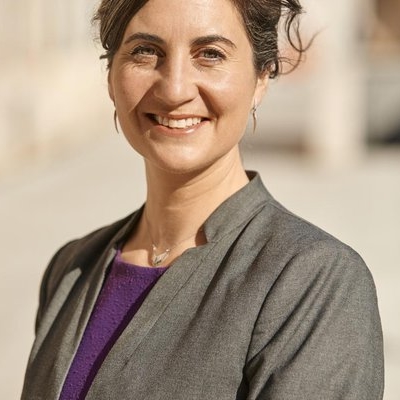
Anna Deparnay Grunenberg | Germany
Member of the European Parliament, Bündnis 90/Die Grünen

Carlos Trias Pintó | Spain
European Economic and Social Committee, Spanish Consumer Protection
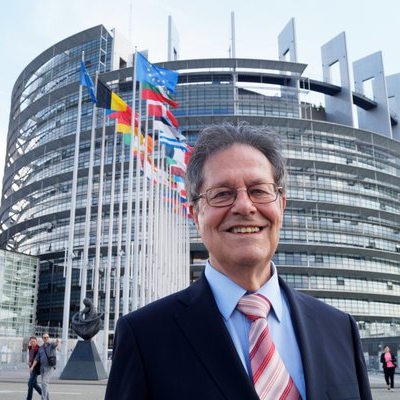
Klaus Buchner, Prof. Dr. | Germany
Member of the European Parliament, ÖDP

Sarah Wiener | Austria and Germany
Entrepreneur, cook, author and EU politician

Thomas Wagnsonner, Mag. | Austria
Member of the European Economic and Social Committee

If you are a politician and you want to support the ECG, please, send an email to politics@econgood.org.