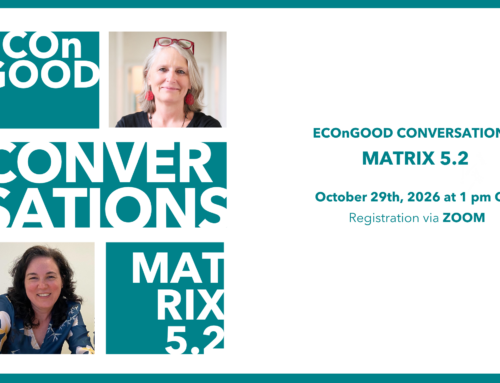

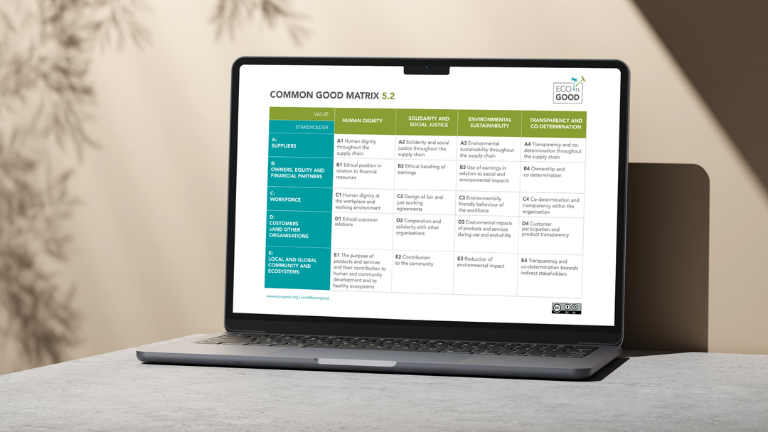
ECOnGOOD has launched the Common Good Matrix 5.2, an updated version of its main framework for helping organisations understand, asses and improve their impact on society and the environment. This practical framework supports any organisation to identify how do their activities contribute to the common good.
The Matrix covers 20 themes related to an organisation’s relationships with its stakeholders, including: suppliers, owners and financial partners, the workforce, customers and other organisations, as well as the local and global community and ecosystems. It is based on the Economy for the Common Good (ECG) four core values: human dignity, solidarity and social justice, ecological sustainability, and transparency and co-determination.
The assessment levels have been improved from previous versions to ensure greater coherence with the general assessment table, which makes it easier to understand how activities are evaluated, identify their current position and recognise what progress towards higher levels of contribution could look like. The scale ranges from baseline to exemplary, providing a structured way to reflect on how decisions and activities affect different stakeholders, society and the planet.
Organisational purpose, life-cycle assesment and the circular economy all remain part of the framework that supports a broader understanding of sustainability, a bridge between purpose and environmental and social consequences of an organisation’s activities. One of the biggest updates compared to previous versions is the digitalisation of the tool, offering a fully functional HTML file, as well as IT tools developed alongside official partners.
- Explore the HTML file.
- Discover Goodbalancer by Silberzebra
- Get to know the Common Good Balance Sheet Module by Leadity
To learn more about the Common Good Matrix 5.2 visit the webpage and join an ECOnGOOD Conversation on Matrix 5.2 in German.